Heinrich Bayer
Los pacientes del doctor GarcíaHeinrich Beyer is a seventeen-year-old German soldier whose brief life at the Klooga massacre turns a small devotional object into the measure of a consequential choice. Sent to the Eastern Front after barely two weeks of training, he is ordered to join a firing squad killing unarmed women. He refuses on grounds of conscience, names his disobedience, and is shot by Hauptsturmführer Kleiber. Adrián Gallardo, who witnesses the scene and takes part in the massacre, first evades what Beyer’s refusal means; afterward, the dead boy’s example becomes a standard against which Adrián’s own survival and complicity are painfully measured.
Identity and Background
Beyer comes from an isolated farm near Bad Tölz, in a comfortable Catholic family of middling landowners. The youngest child, he has two older brothers already mobilized: one serves in northern Italy, while the other, a chemical engineer, has been made director of a militarized factory outside Berlin. Beyer is still studying when the war reaches him. His mother hopes that his youth and the farm’s remoteness will protect him from conscription. Each afternoon she walks to the road to check that haystacks, firewood, and the ruins of an old stable still conceal the farmhouse from view. The precaution is tender and futile: when the authorities come looking, they find him.
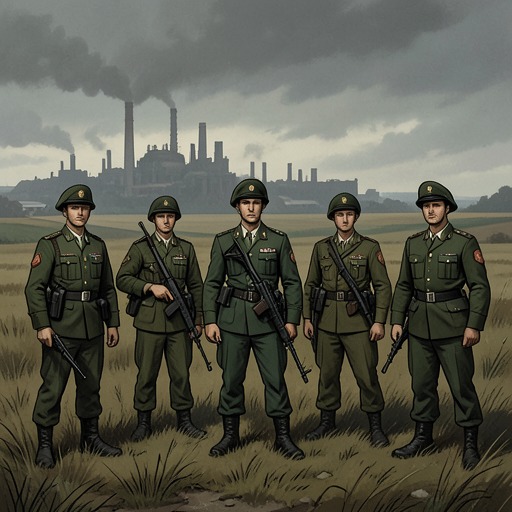
The army gives him a rifle and a uniform, provides less than two weeks of training, and sends him east. That abrupt passage from farm and school to the front is part of his defining circumstance. He does not arrive as a seasoned volunteer whose years of ideological commitment have prepared him for violence; he is a boy swept into the machinery of war, carrying a rural upbringing and a family’s unsuccessful effort to keep him home.
The Scapular and Adrián’s Recognition
At the front, Beyer wears a small scapular around his neck on a crimson cord. During artillery fire, Adrián sees him draw it from under his shirt and kiss it. In a pause, Adrián asks about it, and Beyer shows him the piece of white silk, yellowed by sweat and battlefield dust, bearing an image of the Sacred Heart of Jesus embroidered in red and gold.
The object brings Adrián face to face with his own absent scapular. His mother had hung a similar one around his neck when he left Spain in July 1936, at La Puebla de Arganzón. He remembers kissing it repeatedly, and remembers feeling exposed and unarmed when it was not against his chest. He did not take it with him to Russia; he does not know where it went, imagining it may have been discarded with his belongings after he left his Madrid apartment. Beyer’s worn keepsake therefore marks not only a difference between the two soldiers but a lost connection in Adrián’s own past: the boy’s visible devotion recalls a faith and a form of protection that Adrián no longer possesses.
Beyer asks whether Adrián wants to pray. Adrián cannot explain in German that he has stopped praying: the war in Spain broke the habit, and the Battle of Krasny Bor cost him his faith. He also cannot tell Beyer that he would like to accompany him, murmuring in Spanish a prayer whose rhythm he might recognize, but fears that doing so would be false. Burdened by too many lies, he merely shakes his head. Beyer does not press him. He says that he will pray because it makes him feel better, joins his hands, closes his eyes, and moves his lips in silence.
Adrián stays beside him briefly, watching him pray, then leaves in haste, as if the sight were a threat or a prophecy. Afterward, an unnamed superstition leads him to avoid Beyer. Their next encounter comes on 20 September 1944, when Beyer salutes him from a truck taking him, under force, toward the killing ground. Adrián returns the salute without noticing the difference between their journeys: Beyer has been compelled to go there, while Adrián has come of his own will.
Refusal at Klooga
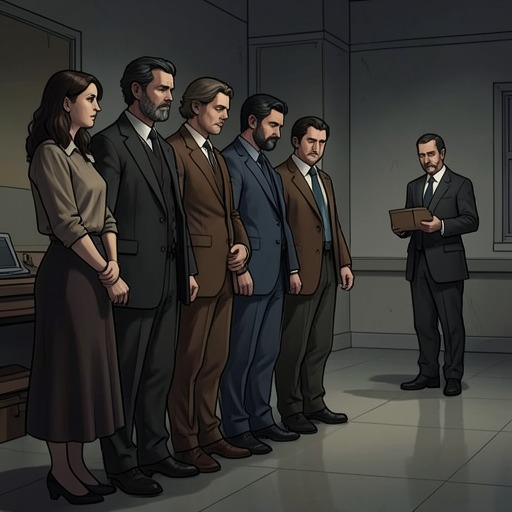
At Klooga, Adrián sees Beyer standing in a firing squad facing exhausted, emaciated prisoners. The women waiting to be shot are unarmed; twenty are arranged in a straight line. Their presence alters Adrián’s view of the soldier he had met in the forest. He recognizes in Beyer’s face the possibility of his own mother and sees a farm-raised boy who can feel the destruction of the woods around him. But the comparison offers no simple innocence: Beyer is standing with a rifle among the men who will kill, and the scapular at his throat cannot by itself prevent him from being forced into the scene.
Adrián initially reads Beyer’s tearful composure as evidence that the murder is inevitable, as though the boy has no way out. He sees the tears running down Beyer’s cheeks, but mistakes his firmness for submission. When Hauptsturmführer Kleiber gives the order to raise their rifles, the others assume firing positions. Beyer alone remains upright, his rifle grounded, his lips moving. The women are praying too. Adrián recognizes that Beyer has stopped crying and is praying, but only after the order has exposed the decision he had refused to see.
Kleiber approaches him and asks whether he heard the command and why he did not carry it out. Beyer answers that he cannot obey because his conscience will not allow him to shoot the women. He understands the consequence and openly acknowledges that refusing an order from a superior is a military offense. His action is neither an escape from the squad nor a misunderstanding: he identifies the command, refuses it, and accepts that punishment is prescribed.
Kleiber presses his pistol to Beyer’s forehead and shoots him. The narration describes the boy’s fall as that of a puppet whose strings have been cut. Kleiber orders another German to fill the vacant place and two Estonian volunteers to remove the body, which he kicks aside. As Beyer is carried away, Adrián sees his right hand closed at his throat, clutching the crimson cord. He has had time to seize the scapular, but not to kiss it.
Death, Complicity, and Narrative Significance
The execution does not stop the massacre. Later that day the firing squad kills one hundred men as well as the one hundred women shot in the morning. The soldiers receive a more generous meal than usual: stewed meat and potatoes, a chocolate bar for every two men, and a bottle of vodka for every four. During the meal, a corporal makes a joke about how well the Jews of Klooga have treated them. Some men laugh; not all do. The ordinary rationing of food and drink, and the attempted camaraderie of the joke, stand beside the organized killing without softening it.
Adrián gets up and walks through the devastated forest until he smells burning flesh. He vomits, sits on a stump, and tries to attend to the bitterness of bile, but memories rush through his mind as if death were waiting behind the last one. He realizes that although he thinks he would not mind dying, he wants to live. He also thinks of killing himself, or provoking his own death as Beyer has done, but his remembered companions and his mother’s religious condemnation crowd the thought. Most sharply, he distinguishes suicide from Beyer’s choice: Beyer has died innocent rather than live as a murderer. Adrián recognizes the act as dignified and brave, and imagines that it might offer Beyer’s mother some consolation, though it cannot return her son.
That recognition does not immediately make Adrián able to accept the meaning of what he has witnessed. He mutters an insult about Beyer, calling him a fool who died for nothing because he thought himself better than the others. The outburst contradicts the admiration he has just felt; it does not undo it. Beyer’s refusal remains an accusation precisely because Adrián has survived by continuing among the killers and has participated in the deaths of two hundred unarmed people. The scapular, seized but never kissed, holds together the faith Beyer acts upon and the faith Adrián believes he has lost. His death makes conscience visible not as a private belief or comforting ritual, but as a refusal that carries an immediate, fatal cost.